
flux/ai-agents
 github.com
Open-source, secure environment with real-world tools for enterprise-grade agents. - e2b-dev/E2B
github.comClaude Code learns from your corrections: self-correcting memory that compounds over 50+ sessions. Context engineering, parallel worktrees, agent teams, and 17 battle-tested skills. - rohitg00/pro-...
github.com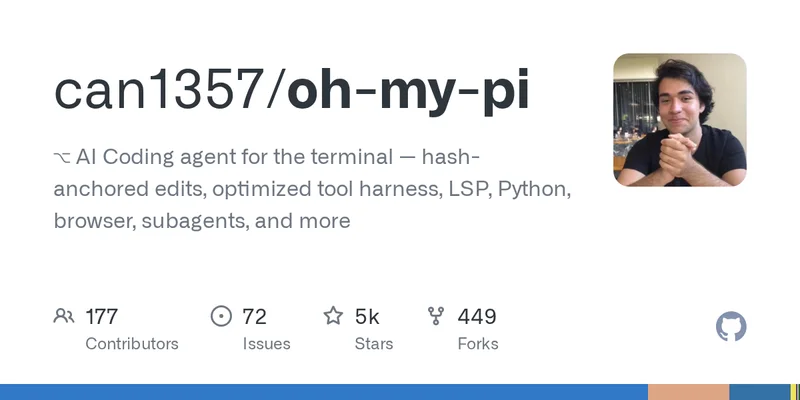
⌥ AI Coding agent for the terminal — hash-anchored edits, optimized tool harness, LSP, Python, browser, subagents, and more - can1357/oh-my-pi
github.com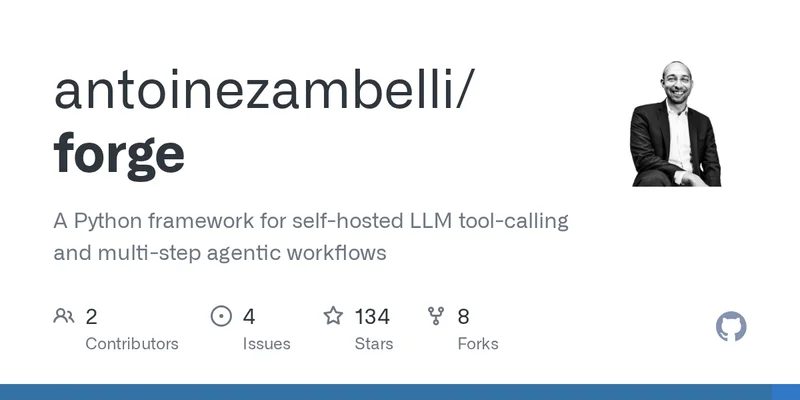
A Python framework for self-hosted LLM tool-calling and multi-step agentic workflows - antoinezambelli/forge
github.com
What are the principles we can use to build LLM-powered software that is actually good enough to put in the hands of production customers? - humanlayer/12-factor-agents
github.com
Langflow is a powerful tool for building and deploying AI-powered agents and workflows. - langflow-ai/langflow
github.com
Supercharge AI coding agents with portable skills. Install, translate & share skills across Claude Code, Cursor, Codex, Copilot & 40 more - rohitg00/skillkit
github.com
Local AI anywhere, for everyone — LLM inference, chat UI, voice, agents, workflows, RAG, and image generation. No cloud, no subscriptions. - Light-Heart-Labs/DreamServer
github.com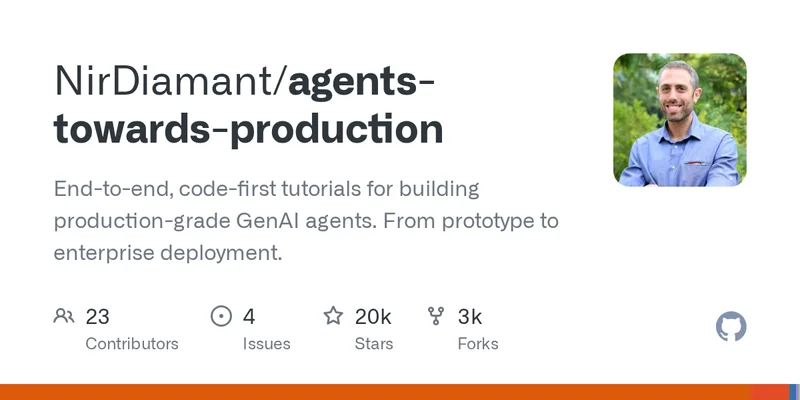
End-to-end, code-first tutorials for building production-grade GenAI agents. From prototype to enterprise deployment. - NirDiamant/agents-towards-production
 arxiv.org
Large language models increasingly need to accumulate and reuse historical information in long-term assistants and agent systems. Simply expanding the context window is costly and often fails to ensure effective context utilization. We propose $δ$-mem, a lightweight memory mechanism that augments a frozen full-attention backbone with a compact online state of associative memory. $δ$-mem compresses past information into a fixed-size state matrix updated by delta-rule learning, and uses its readout to generate low-rank corrections to the backbone’s attention computation during generation. With only an $8\times8$ online memory state, $δ$-mem improves the average score to $1.10\times$ that of the frozen backbone and $1.15\times$ that of the strongest non-$δ$-mem memory baseline. It achieves larger gains on memory-heavy benchmarks, reaching $1.31\times$ on MemoryAgentBench and $1.20\times$ on LoCoMo, while largely preserving general capabilities. These results show that effective memory can be realized through a compact online state directly coupled with attention computation, without full fine-tuning, backbone replacement, or explicit context extension.